

When I launched Sip of Culture in 2020, my mission was to present the traditions and artistic practices of different countries and cultures. To me, this was not just about presenting my readers with interesting stories or fun facts; it was about finding a way to promote tolerance and to encourage people to open their hearts to what they may have previously viewed as ‘other’, ‘foreign’, or ‘distant’.
Today, I am excited to introduce the ancient Ukrainian art practice, Pysanky. Fitting with Sip of Culture‘s goal of celebrating and sharing cultures, I am delighted to introduce this craft by interviewing the Polish American artist, Katherine Alexander.
Called pysanky, this practice of ‘writing’ on eggs is generally associated with Easter, although historical accounts reveal that it preceded Ukraine’s adoption of Christianity. Explaining the history of this ancient art, Katherine shared:
“Pysanky is a traditional Ukrainian art and translates as “to write”, since we write with wax. The art is over 3,000 years old and originated as part of spring equinox celebrations. The eggshells are symbolic of the start of the hen’s laying season and the long-awaited arrival of spring. In honour of this tradition, my pysanky are inspired by nature and the end to the hardship of winter.”
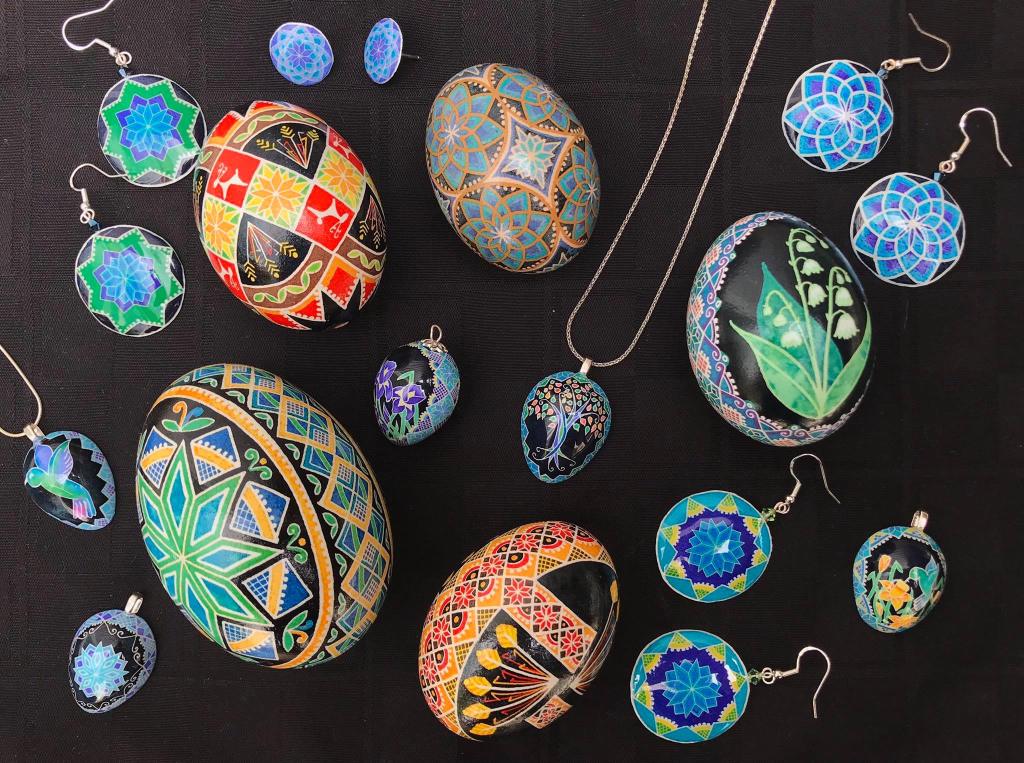
(Source: Katherine Alexander Art on Facebook)
What is the pysanky technique?
Painting and decorating eggs for Easter is a common practice in Slavic cultures. However, the art of pysanky is quite different from simply dipping a boiled egg into a jar of dye.
“Pysanky artists write on real eggshells with melted wax and then progress through an alternating series of dye and additional wax. The traditional tool is called a kistka and it acts like a tiny funnel. It’s held over a candle to melt the wax so the artist can write directly onto the eggshell. This preserves that colour on the shell when the egg is dipped into a new dye. This process is also known as Batik or “wax resist”. In the end, all the layers of wax are melted off to reveal the colours that remain,” Katherine explained.
Nowadays, pysanky artists are taking this a step further, making jewellery from their written eggs.
I remember the first time I watched a behind-the-scenes video of Katherine transforming her pysanky into jewellery. In the video, she held a pysanka in front of the camera and broke it into pieces:
“Transforming eggshells into jewellery is a newer trend in pysanky, and I’m thrilled to see how artists are pushing these limits. After a significantly steep learning curve, I’ve adapted a method to reinforce the shells with resin so they are strong enough for everyday wear. Sourcing my sterling silver findings has taken both research and trial and error, but I’ve been successfully showing my jewellery in juried art fairs for two years now. It’s incredibly satisfying to hear people gasp when realising that they are looking at actual eggshells,” Katherine admitted.
A meditative art practice anyone can take up
While this may be a traditional Ukrainian art that is primarily associated with Easter, pysanky is also a meditative practice that is open to people of all faiths and cultures. Katherine stressed this during our interview, noting:
“While this art has deep cultural significance, it is an open practice for anyone who welcomes spring. I would encourage any beginner to give themselves extra patience and try simple designs first while understanding the process.”
Further encouraging new artists to try pysanky, Katherine shared her favourite supply stores: PysankyUSA and Ukrainian EggCessories, which have all the tools and books a beginner would need.
Finally, when asked how she discovered her passion for pysanky and where she continues finding inspiration today, Katherine shared:
“My Polish mother taught me this craft when I was nine years old. We would share the same candle and stay up late at night talking and creating. My current inspiration comes from discovering what limits I can push with this beautiful but challenging medium. I enjoy the classic designs of my ancestors, but my hands keep reaching for modern bright colours and whimsical designs.”
If you want to learn more about this art practice and view Katherine’s work, visit her website.
 Sip of Culture