
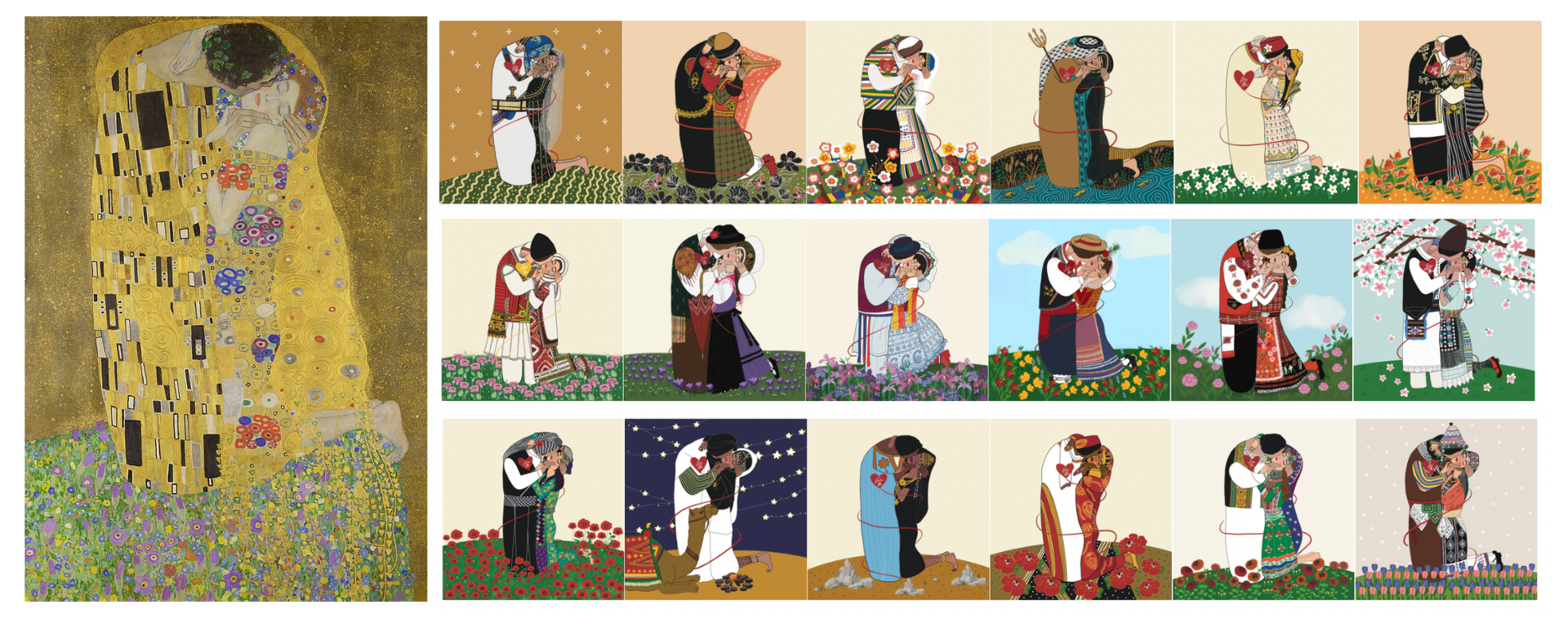
It takes a special kind of artist to awaken a dormant blog but that’s what Kim Sinae has done.
Sip of Culture went into a sort of hibernation for a couple of years but when I came across Sinae’s The Kiss series on Instagram, I knew I had to invite her for an interview.
Sinae is a self-taught Korean artist who has drawn 36 — and counting — recreations of Gustav Klimt’s The Kiss on Procreate.
‘I saw the original in Vienna and stood in front of it for almost an hour,’ she said, when asked why she chose The Kiss.
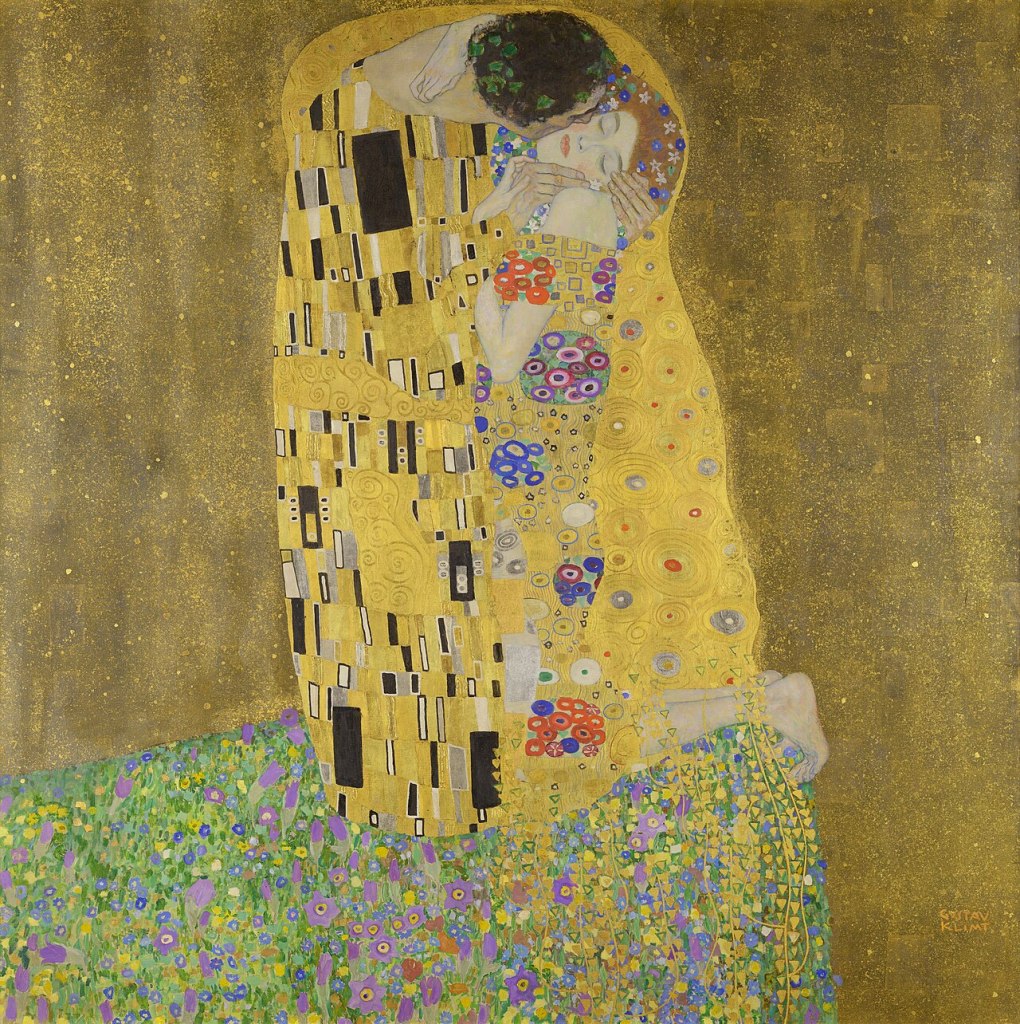
‘A while later, living in Qatar, I was doodling and thought — what if the two people in that pose were wearing Korean traditional dress? That was the first version in my head. Then I thought, I’m living in the Middle East right now. This could be a way to show people the culture I’m actually seeing here.’
But her first illustration wasn’t for Korea nor Qatar.
It was for Palestine.
I asked why she chose Palestine and the simplicity of her answer surprised me: ‘One of my closest friends in Qatar was Palestinian. She was the person I asked about everything — food, weddings, family customs. She was incredibly generous about explaining her culture to me. And the dress was stunning. The embroidery, the colours, the way each region has its own patterns. So the first one was really for her.’
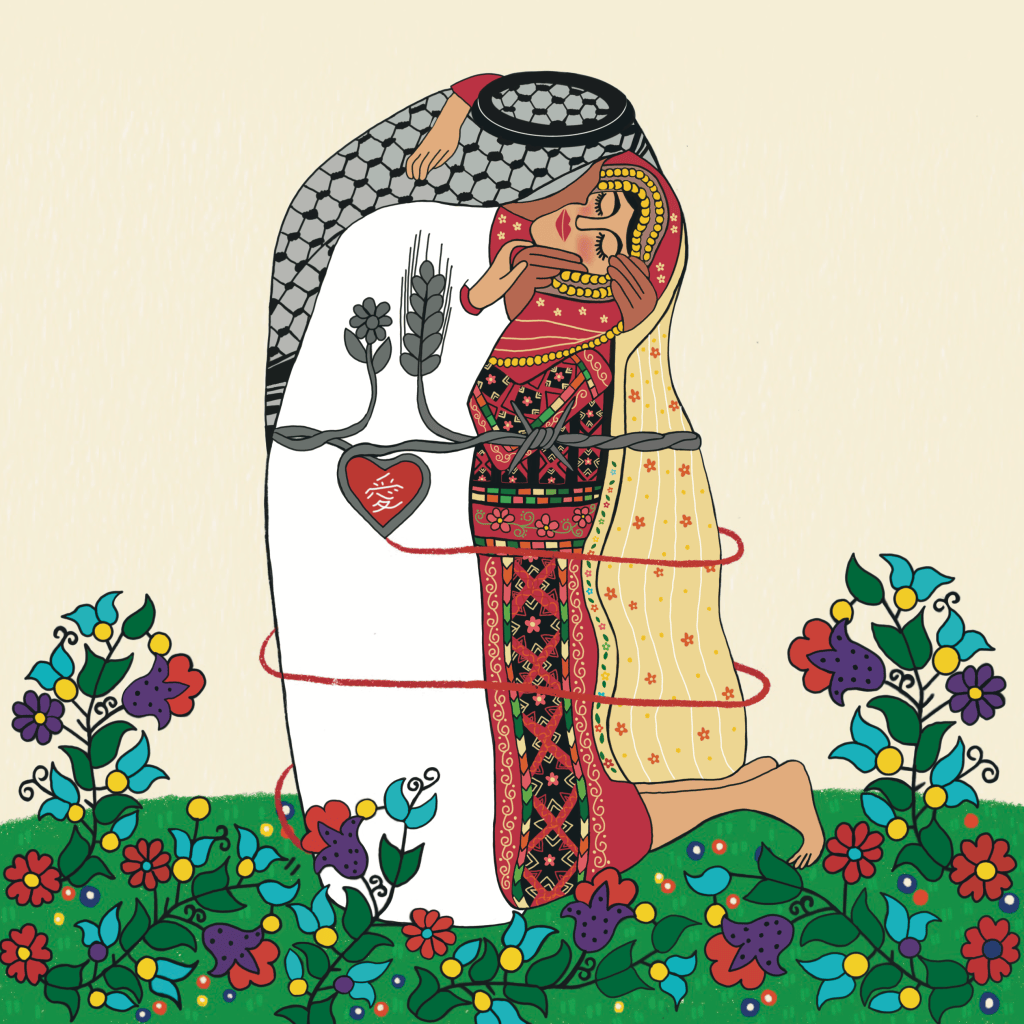
Sinae had no idea that her illustration would be so popular when she drew it in February 2022.
‘It did well when I first drew it, but after Gaza it took on a completely different life,’ she said. ‘People wanted it in a way that wasn’t about art anymore. It was used in campaigns. I made donations through it, and drew a separate piece to give away for free so people could use it as a symbol.’
Her next two illustrations were inspired by Algeria and Libya. After that, Sinae said, ‘something had shifted’.
‘Each post was hitting a thousand views quickly, and my comments filled up with the same request: can you do my country next?’
Now, she has 36 illustrations of countries from the Middle East, North Africa, and the Balkans.
As a Balkan myself — specifically, a Bulgarian woman — I was interested in finding out more about her illustration for Bulgaria. I found out that Sinae did more than just focus on a country’s national dress; she delved into their culture and history.
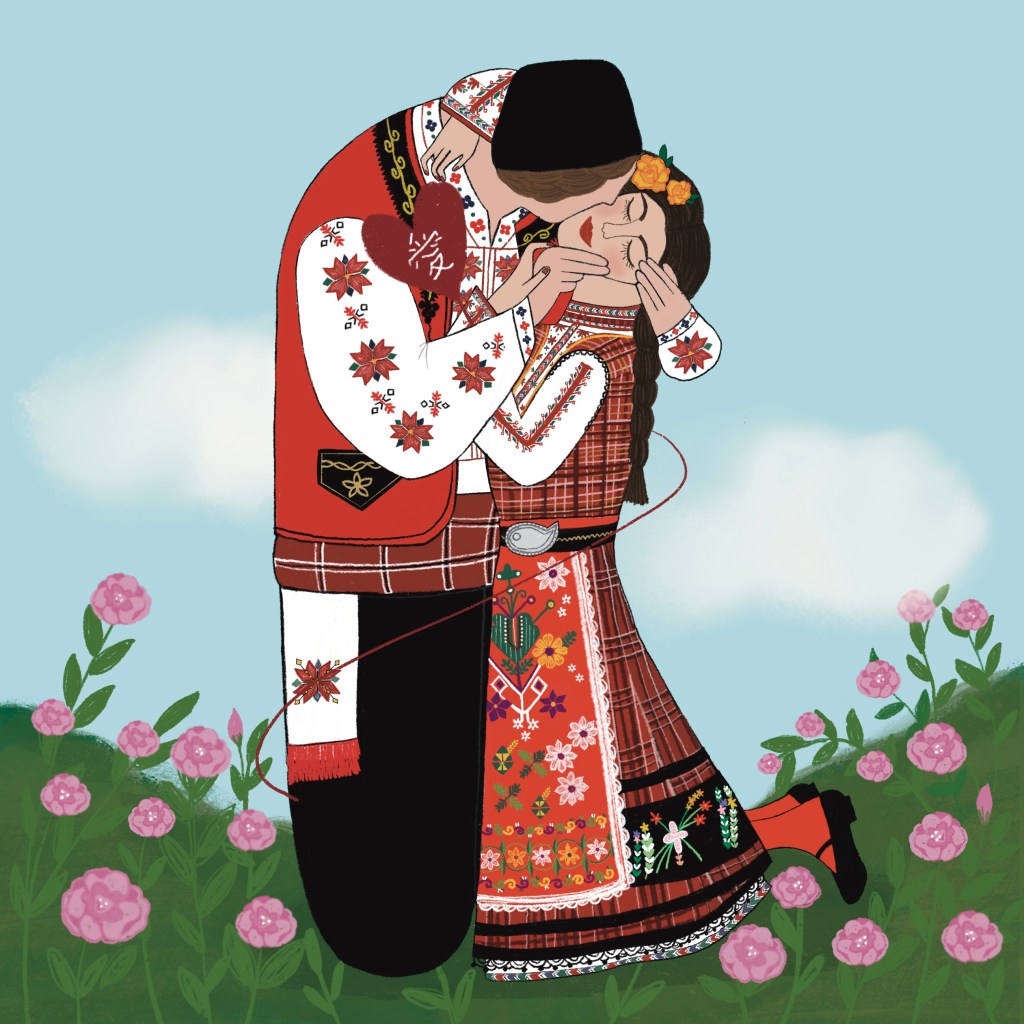
‘Before I researched it, what I knew about Bulgaria was what most Koreans know — yogurt, fermented foods, roses. Working on this piece taught me a lot more,’ she said.
‘Bulgaria was the first country in Eastern Europe to open a Korean language department. And apparently, when Korean companies expand into Eastern Europe, Bulgaria is often the most welcoming. A lot of young Bulgarians study Korean, and I’ve met several who speak it well.
There’s also a historical parallel I found moving. Korea created its own alphabet, Hangul. Bulgaria is where the Cyrillic alphabet was developed. Two countries that each built their own writing system, centuries apart, on opposite sides of the world,’ Sinae said.
And although she plans to have 50 illustrations completed by the end of the year, Sinae’s goal for the future is far more ambitious.
‘Long term, I want all 195 — every country in the world. Each piece takes me at least three days, so I know how that sounds. But four years in, I still don’t want to stop. Korea will be last. Going around the whole world first, and coming home at the end. And beyond that, I’d love to be invited to exhibit at the Belvedere in Vienna, where the original Kiss hangs. That’s where this started.’
Aside from the illustrations she posts online, Sinae also accepts commissions and, she admitted, it is this work that is her favourite.
‘Most of them [commissions] come from international couples, and I ask them to tell me how they met. What comes back is always a story about someone choosing a person over distance, over language, over everything that made it difficult.’
Love, not surprisingly, sits at the centre of Sinae’s work.
‘As the world becomes more machine-centred — love is going to be the most valuable thing we have,’ she said. ‘The way people love and care for each other is precious, and it will stay analogue forever. Because nothing can replace it. That’s the value I wanted to put into my work. The clothing changes completely from country to country. The colours, the fabrics, the symbols. But the way two people hold each other doesn’t change at all.’
And in this machine-centred world where everybody suspects that what they see online is AI-generated, Sinae makes a point of showing each step of her work, from sketch to completion.
When asked whether she uses AI at all, Sinae said the technology only helps her with research.
‘But most of my research still isn’t AI. I ask my followers, and they send me references. Different people send different things, so I cross-check them. I also watch a lot of documentaries about whichever country I’m working on. AI is more like an assistant. It’s fast and it knows things I don’t. But it doesn’t decide anything — which country, which region, how a piece should feel. That’s mine.’
Sinae further added that one thing this project has taught her is that she can’t create the entire series alone.
‘I used to think research meant finding the right photo online but it doesn’t. Traditional dress changes from region to region, sometimes village to village. No amount of searching gets you there. Only people do.
So now I end every post with a line: if I got something wrong, please tell me.
And people do.’

